
New life on Mount Kundudo
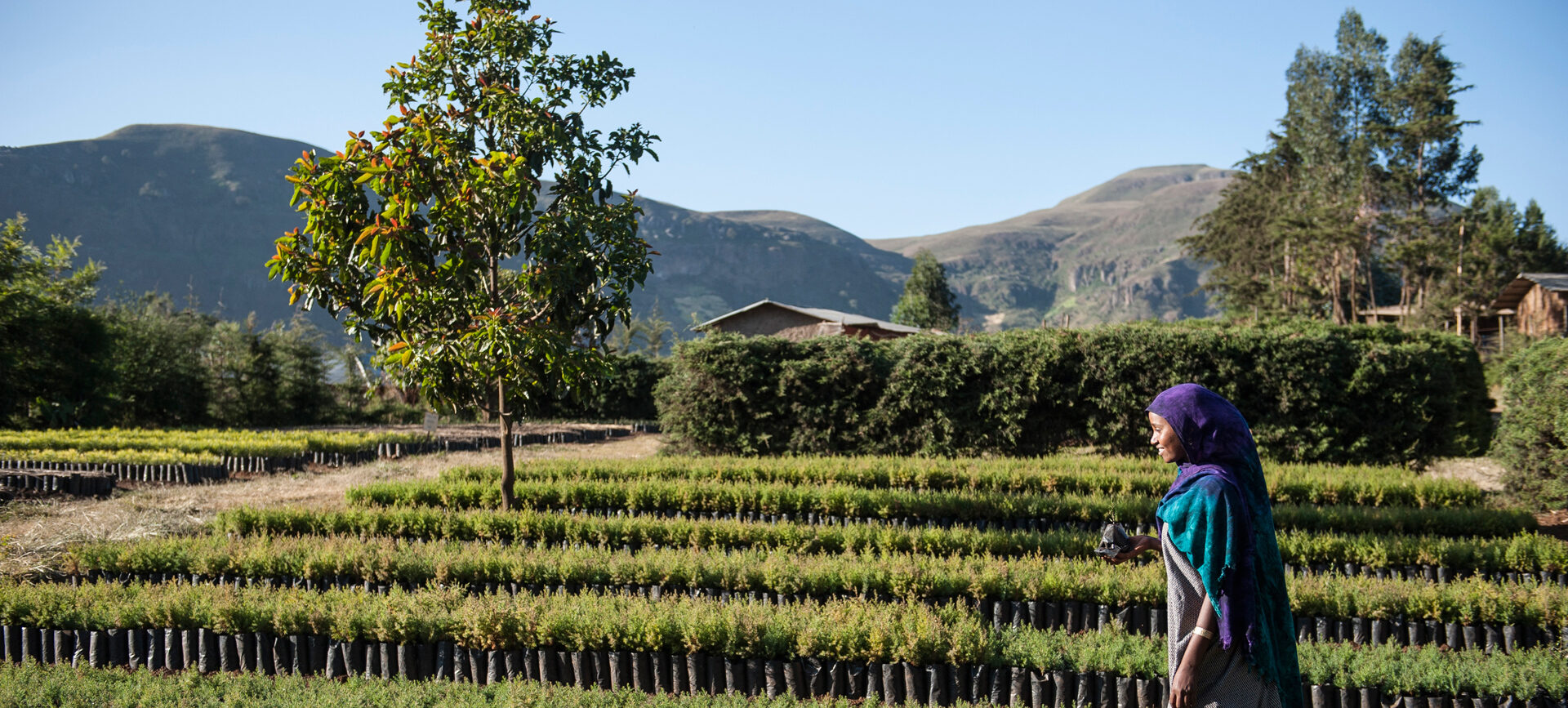
900 kilometres of terracing, about 10 million seedlings: Menschen für Menschen is implementing a huge reafforestation project on the Kundudo plateau in eastern Ethiopia. It is representative of the Foundation’s goal of restoring the livelihoods of the people of Ethiopia and securing them in the long term. In this way, we can prevent emergency situations such as the severe food shortage being experienced by parts of Ethiopia as a result of the continuing drought.
The other villagers had warned Moilud Ahmed not to build his hut at the foot of the hill. When the big rains come, it will be swept away. “I knew that it is dangerous to live so close to the slope,” says the 35-year-old smallholder today. But the population in the area is growing, and land for cultivation and building is becoming scarce. “Until then we had lived in a hut on my parents’ property, but when my wife became pregnant again we wanted our own home,” says Moilud.
So they built at the foot of Tulu Korke, a hill on which only scrub and a few solitary trees grew. In the rainy season the water cascaded down the slopes. “I recognised the danger,” says Moilud. “But I thought if I dug a trench and built a low wall, we would be safe.”

However, that was not enough. In the spring and late summer, when it rains continuously for weeks, the family’s fields and vegetable plots sank in a morass. A major part of the harvest was lost. Even in their hut, the family often stood ankle-deep in water. “As farmers, we should look forward to the rain,” says Moilud. “But at that point we were just afraid of it.”
"...it was already too late"
“In earlier days we didn’t experience these floods,” says Hassan Jami as he looks down over the barren mountain scenery. The 65-year-old shepherd with a curly grey and white beard was born in this area. He still remembers clearly how it used to look in his childhood. “The valleys and slopes were covered with dense forest, in which we hunted deer,” he says. But we had to be careful: black panthers were often prowling in the undergrowth.
“The forests supplied the people with meat, berries and medicinal herbs,” says Hassan. “When we finally grasped the fact that they also protected us from flash floods, it was already too late.”

The Kundudo Plateau is about 600 kilometres to the east of Addis Ababa, not far from the border with Somalia. The area is especially famous for the village Ejersa Goro, where Haile Selassie, Ethiopian ruler and last Emperor of Abyssinia, was born in 1892. A few kilometres further stands the mountain after which the region was named: the 3,000-metre high Mount Kundudo. It is a bizarre sight, with its luscious green slopes that rise out of the landscape like a gigantic staircase. From its peak it is claimed that in good weather one can see as far as the 250 kilometres distant Gulf of Aden. The mountain is an attraction in every respect, and was once popular with tourists.
Demand for timber resulted in deforestation
In the past decades a less attractive spectacle has taken place at the foot of Mount Kundudo. The forests in which shepherd Hassan Jami hunted as a child gradually fell victim to the timber consumption of the growing population. The drastic tree clearance was not without consequences for the approx. 55,000 people on the Kundudo Plateau who today make their living mainly from agriculture and livestock farming. In addition to the floods that endangered humans, livestock and crops during the rainy season they suffered declining agricultural yields because the flash floods washed away valuable humus. A further problem is the water supply. Where rainwater run-off was unchecked, less water seeps into the soil. The groundwater supply can hardly be regenerated; wells and spring developments run dry.
“The situation is continuing to deteriorate,” says Gebeyehu Seyoum, 44. The agricultural economist is the manager of a large-scale reforestation project initiated by the Menschen für Menschen Foundation on the Kundudo Plateau in 2012. “Our research showed that the people of this region were suffering increasingly from flooding as well as water and food shortages,” says GebeyehuSeyoum.

The reason was clear: The lack of trees had upset the ecosystem in the region. According to the principle “Aid for self- development” Menschen für Menschen developed an ambitious plan: The forest should return to Kundudo… and with it the life expectation of the people.
Five years later, the project has already left visible traces. Broad ridges are now covered with a maze of soil bunds to arrest the cascading water masses, and at the same time create horizontal surfaces on which seedlings can grow. A total of 500 kilometres of terraces are planned in the region. A further 400 kilometres of terraces will be constructed on the flatter slopes, providing space for field crops. Huge wire baskets filled with stones are to be installed where erosion has left deep scars in the landscape. These are intended to stop the flow of water and soil, ensuring that the huge gullies close up again. A total of 125 ‘gabions’ of this type are proposed on the Kundudo Plateau.
Villagers themselves carry out the work
“Without the support of the local population, we would not have been able to organise a project of this size,” says Gebeyehu Seyoum. Not least because it was the local residents themselves who built a system of terraces over the entire sloping terrain.
A common early morning sight for several years now has been the construction crews, consisting of several hundred men, marching up the mountainside with spades and picks on their shoulders. Against a daily allowance they receive from the Foundation, they labour to hew solid steps into the slopes with their bare hands.

In addition, soil-stabilizing vetiver and seedlings are being planted. In this way, the local people are fundamentally changing the landscape of their region, with the aim of returning it to its original state.
The project is compatible with Ethiopia’s plans to build an economy with low carbon dioxide emissions. It is a high-flying goal: by 2025 Ethiopia is to become a carbon dioxide-neutral and climate-friendly country with medium incomes. The “Climate-Resilient Green Economy” (CRGE) strategy prepared for this purpose embraces three goals: reduced emissions, reduced vulnerability to the consequences of climate change and securing economic growth.
The massive effort on Mount Kundudo is all the more remarkable because it is not necessarily those who performed the work who will benefit from it, but rather their children and grandchildren. For the past two centuries this has been a principle that forestry circumscribes with the term ‘sustainability’.
Confiers and deciduous trees are now thriving
“The local people have understood that the woodland must be restored,” says Gebeyehu Seyoum. “The problem was that initially they did not trust us.” The reason was a failed reforestation programme the government had launched in the region about 30 years ago. “At that time the seedlings were weak and the terraces poorly laid out,” says Seyoum. “Our first task was to convince the people that we could do it better.” On the ridges of the Gara Guracha, ‘Black Mountain’, there can be no doubt that the new project will be more successful. Where up until a few years ago only a few thistles clung to the meagre soil, there is now a dense covering of conifers and deciduous trees. Seyoum stops next to one of them, a man-high silk oak, and grasps the trunk with his hand – a trunk that used to be only as thick as a broomstick. “In ten years’ time this tree can be over 15 metres high,” he says. The new growth is also making a noticeable difference at the foot of the Gara Guracha: the springs and wells in the valley now yield significantly more water.
The situation has also eased at the foot of Tulu Korke. Moilud Ahmed walks through his vegetable garden, radiating optimism. Beans and fat cabbages grow right and left, wheat and sorghum sway in the breeze on the flat foothills of Tulu Korke.
A small eucalyptus copse supplies the family with wood. Further up, the terraces can be discerned as fine horizontal lines. When the heavy rains fell in the late summer of last year, the terraces retained the water for the main part. “The floods have diminished,” says Moilud and looks over to the mountain that had been his enemy, but will soon be his friend again. “When the forest has been restored, my children and grandchildren will also be able to live here.”