
Bright prospects
Connections to the future
Around 60 percent of Ethiopians live from agriculture. At the same time, the country is modernising in leaps and bounds. Many companies are looking for well-trained technical specialists, engineers and mechanics, but there is a shortage of them. On the other hand, unemployment is particularly high among the younger generation. In order to close the gaps and provide prospects, we are building, renovating and equipping vocational schools throughout the country. We have also been running our own technical college, the ATTC, in Harar since 1992. Because a good vocational education is the key to a better future.
Professionals of tomorrow
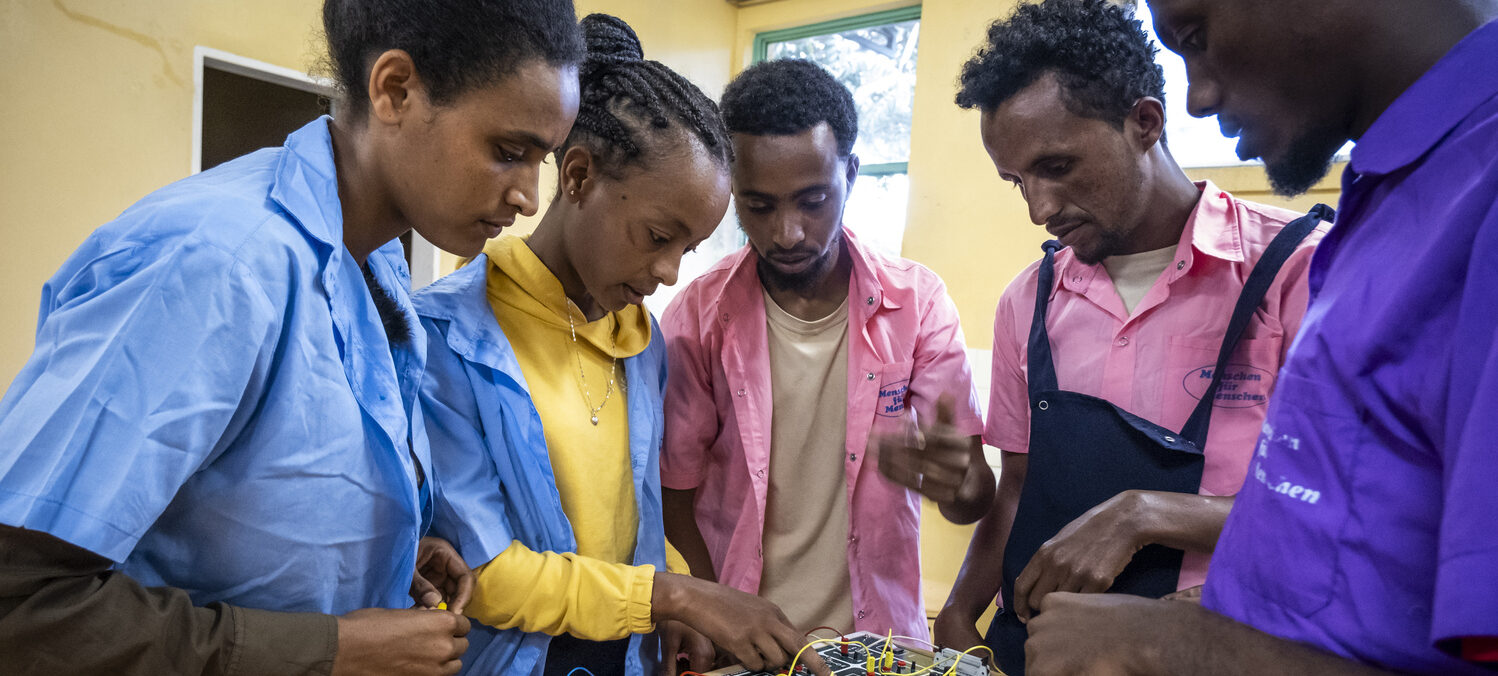
The first task is to untangle the cables. They lay unused in the drawer of the course room for weeks. “After the holidays, we always need something to get us back into it,” admits Jerusalem Bekana, a student of electrical and electronic engineering. Then the slender 22-year-old fishes several yellow, red and black cables out of the tangle and plugs them into a modulator. In the communications engineering seminar, she and her fellow students learn how to transmit information over long distances.
Four days ago, Jerusalem returned to the Agro Technical and Technology College (ATTC) in Harar. She has used her free time to prepare for her courses in this final year of study. Jerusalem asked former students for teaching material and researched on the internet. “I want to continue to improve my performance and find a really good job.”
To pave the way to a successful professional future for motivated young people like her and to provide the growing Ethiopian economy with skilled labour, Menschen für Menschen founded the ATTC more than 30 years ago. The graduates are in high demand. In addition to electrical and electronic engineering, students can also complete a Bachelor’s degree in manufacturing and automotive engineering. The study programme is free of charge: machines, tools, work clothing, textbooks, accommodation and catering for the 471 students are funded by donations and grants from German companies, such as Bürkert – the Swabian technology company funds training for around 40 women, including Jerusalem.
Jerusalem’s path to a professional future
As one of four siblings, she grew up in Fincha in the state of Oromia, 800 kilometres to the west. There are two hydroelectric power stations on the outskirts of the city. Jerusalem has always been fascinated by how they produce electricity.
“I’ve wanted to be an electrical engineer since I was a child,” she explains. When she heard about the college, she applied. She still remembers her first days at the ATTC in detail. Jerusalem hardly spoke to the five other young women in her dormitory at the time. “We had never been so far away from home before and we were all very shy,” she says. “It’s hard to imagine today.”
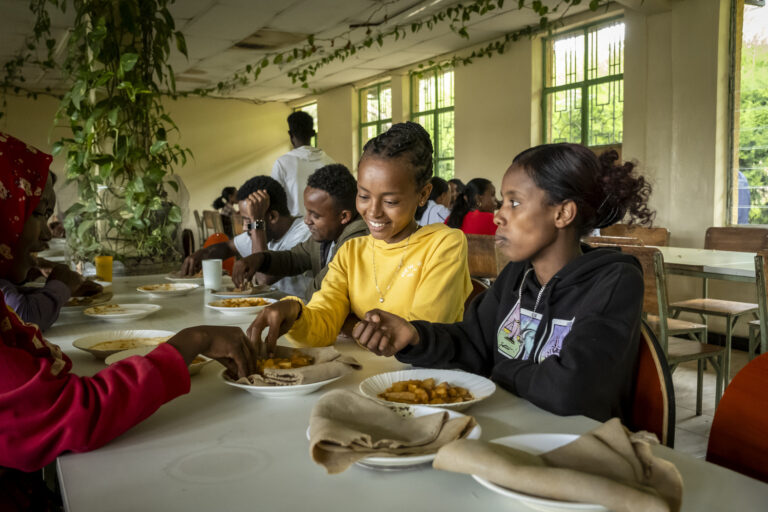
The students, who come from different regions of Ethiopia and belong to different ethnicities and religions, have become close friends. They help each other with the seminar tasks and go to the library together. When one of them goes to a church service at lunchtime or in the evening, the others take her food from the canteen. At the weekend, the girls sometimes go shopping in the city centre or watch films on their mobile phones in the evening.
“I will miss the togetherness here the most,” says Jerusalem. After her studies, she would like to work at Ethio Telecom, the nationwide internet and telephone service provider. “We live in the information age,” she says. “Before, we used to know very little about other places in the world, but today we can google everything and communicate with people everywhere without any problems.”
Before she can realise her career aspirations, Jerusalem still has to pass a few written exams and submit her final practical project. Jerusalem is planning to develop a traffic light system that indicates more than red, amber and green. “We want pedestrians to see how much time they have to cross the road,” she explains. “Here, too, communication can improve people’s lives.”