Into the future with solar power
Building together
Unemployment among young Ethiopians is high. There is a shortage of job offers, especially outside the larger urban centres. We organise practical vocational training to offer women and men prospects. Start-up capital from a new innovation- and start-up programme co-financed by the EU will enable young entrepreneurs to turn their business ideas into reality. They create hope, gain success and create work for others.
Building a future with craftmanship
When Fikade Wurga had his school-leaving certificate in his pocket, he considered what he could do to earn money in Hawariat. What’s missing? What do the people need?
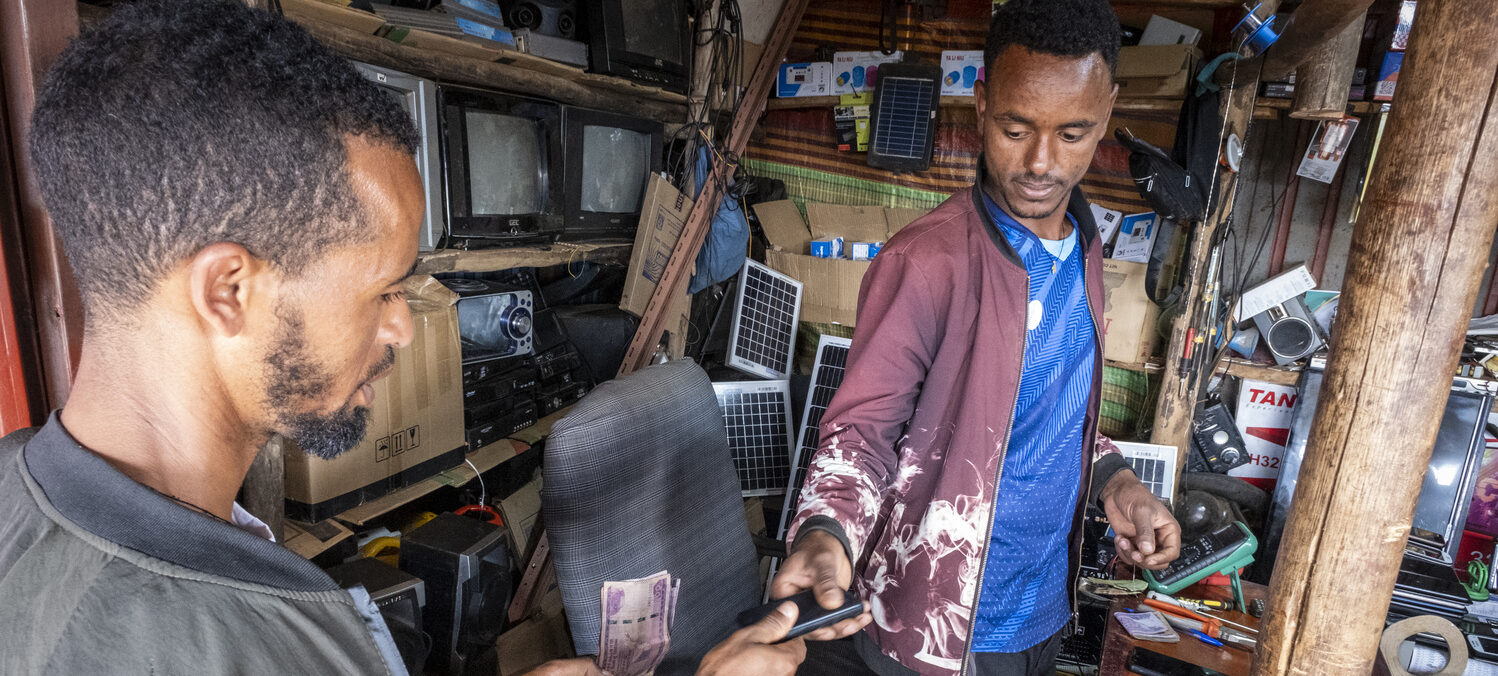
“Many farmers here use old mobile phones. But no one knows how to fix them,” says the 24-year-old, while replacing the battery of a mobile phone. Stacked behind him are speakers, radios and televisions. Mitiku Teka sits opposite the worktable and solders a cable. For three years, the two have been running an electronics shop together with a repair shop.
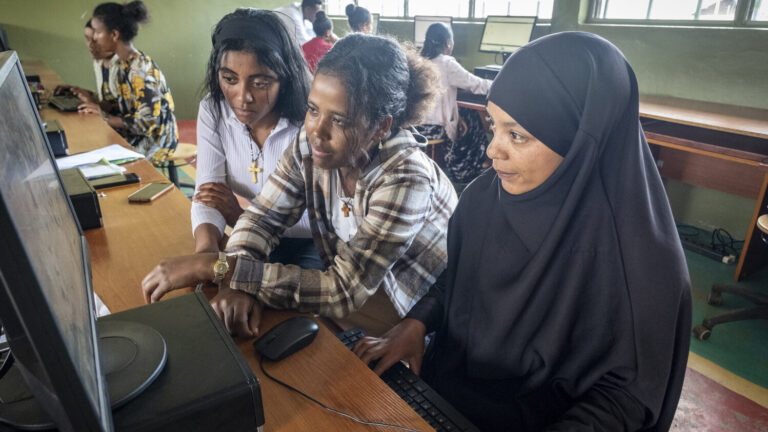
They got to know each other during their training in electrical and electronic engineering at a technical vocational training centre that was built by Menschen für Menschen on the outskirts of Hawariat 15 years ago. There you can also learn professions such as tailoring, metal construction, IT or automotive mechanics. “Our furniture manufacturers are the most successful,” says Director Tizazu Fikadu Bereka proudly. Many graduates later set up their own businesses, he reports. The centre supports them in this process with machines from the final projects or when opening bank accounts. The aim is for young people to be able to earn their own income on a permanent basis and not to be dependent on the few job offers in public authorities.
Fikade and Mitiku pooled their savings for their start-up and bought screwdrivers, measuring instruments and soldering irons. The local government provided them with a small corrugated iron hut for their shop. At first, they mainly repaired mobile phones. Gradually they expanded their services. In the first few years, they generated around 120,000 birr in profits, equivalent to around €650. “Not bad,” says Fikade. “But we knew that more was possible.”
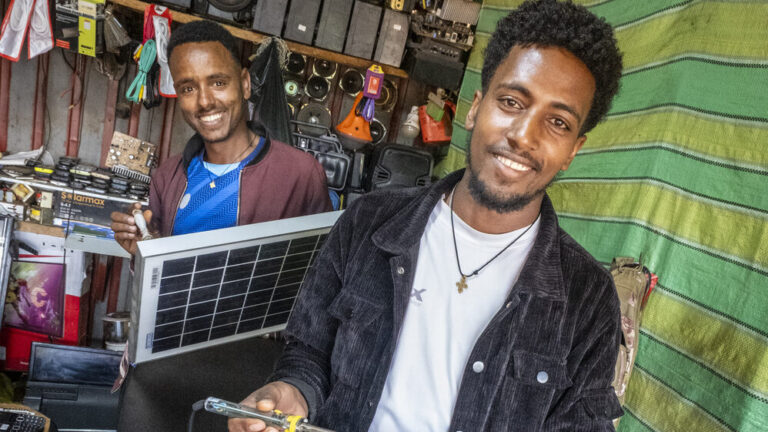
Especially with solar technology. Electricity is often cut in the small town, and many villages in the surrounding area are not connected to the grid. “So the demand is huge,” says Fikade. With this plan in mind, the two signed up for a new training programme run by Menschen für Menschen at their old vocational training centre. During the five-day workshop, they worked on their business plan and developed marketing strategies.
The aim of the training is to prepare young entrepreneurs for an EU-co-financed support programme of the Business Incubation Centre Ethiopia (BIC) in Addis Ababa. Above all, it supports sustainable business ideas in agriculture and technology. After the course, the graduates can apply to BIC for a grant of €1,000. Fikade and Mitiku were awarded the grant. They invested the money in their first solar panels, which they sold and installed in order to reinvest the earnings. The new business paid off and within a year they made an additional profit of more than €550.
In the future, the two men want to expand their business. While today, depending on the order situation, up to four day labourers work for them, they would like to employ one or two of them as permanent employees. In addition, they want to rent a larger shop and build a warehouse. “We need more space to present our products,” says Fikade. Seven years after he graduated from high school, Fikade’s plan worked: his services make everyday life easier for people in his home town. A business idea became a company – and two graduates became employers.
“The city has changed with the new businesses of our students: successful people buy from the market, invest in the city or employ other people.”