
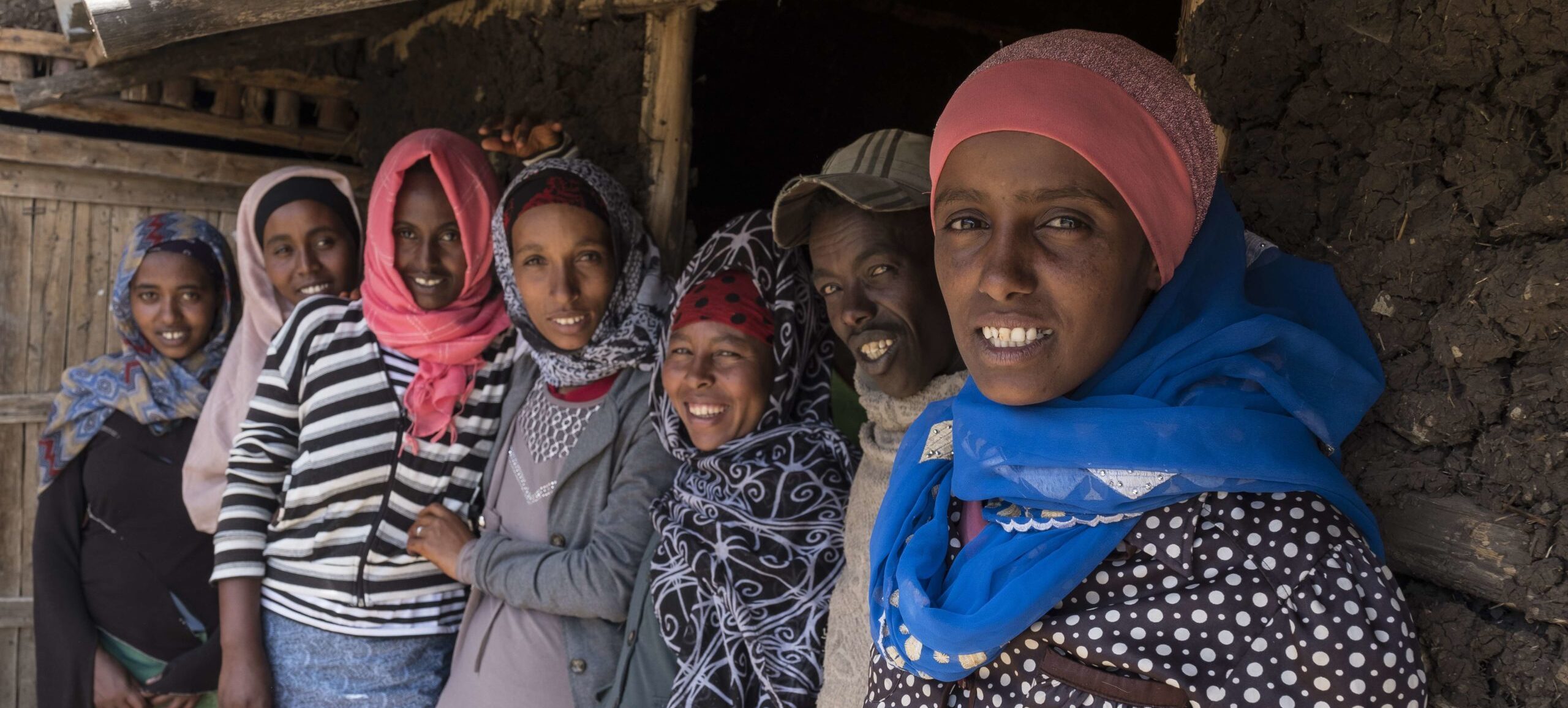
Self-woven future
Project area: Wore Illu
The little fertile soil that is available in the remote rural region is hardly sufficient to feed the growing population. Many families are suffering from hunger. There is usually only work in the fields and in the house of one’s own family – beyond that, young people have little opportunity to earn their own income.
But her dream of escaping from her plight to Saudi Arabia was not fulfilled. Week after week in a foreign country, Aysha was consumed by the longing for her son. “I was depressed,” she remembers.

Creating a perspective in the home country
In the autumn of 2013 the Ethiopian government prohibited the emigration of low-skilled workers to the Near East. There had been a growing number of reports of mistreatment of women. Saudi Arabia, one of the favoured destinations, had also deported several thousand illegal Ethiopian workers. Nevertheless, still today many Ethiopians are leaving their home country. They see no other way of escape from their poverty.
Together with eleven other women and three men, in early 2018 Aysha participated in a job training course organised by Menschen für Menschen in Hochecho. In somewhat more than a month she learned how to weave artistic carpets from sheep’s wool and make plastic bowls. After the course, the participants formed a cooperative. They meet three times a week, alternating between spinning and weaving, as well as making the bowls from thin strips of plastic.

The road of independence


He was a good student, but in Hochecho a school education finished with the eighth class. It was inconceivable for him to set off on the long trek to the next secondary school. For the next five years Kedir stayed at home, helped his parents as much as he could in the fields and taking care of the animals. He was unable to secure a job, because he would have had to lift things or walk long distances.
His handicap is no hindrance to weaving and spinning, or making plastic plates. He can work just as well as the others. “I feel free here,” says Kedir. He still lives with his parents. But that will change soon. “I want to finally lead an independent life and rely on nobody.”
Weaving carpets instead of cutting down forests
The job training of Menschen für Menschen gave Yeshi an alternative. During the one-month weaving course she and the other participants were paid the equivalent of 90 euros, because she was unable to earn a wage during this time. The money was even enough to buy a sheep and a few chickens. Through the sale of eggs, Yeshi was able to care for her children, and her 15-year-old daughter Kemila can at long last go to school on a regular basis.
Like Yeshi, all the members of the carpet group live from this kind of side-line job that she started with the help of Menschen für Menschen. Depending on their size, their carpets sell for between four and 15 euros. Most of the profits are invested in new wool, plastic or other materials from the market and they are able to save around 26,000 birr, about 800 euros. That money has already been paid into a bank account. “When we have enough money, we want to buy a delivery van,” says Yeshi. “It will enable us to take our products to the bigger markets, where we will also earn more.”
It’s an ambitious plan, but the carpet weavers are confident that they will succeed. The job training has given them confidence. “Earlier they would not even have dared to express an opinion. Today they feel confident and strong,” says social worker Zumra. She is particularly proud of Yeshi, who has assumed responsibility not only as speaker of the group. “I used to be plagued by concerns for the future,” says Yeshi. “Today I am no longer afraid, and I would like others who are in the same position as I was to have such an opportunity.”
The next generation
