
Drinking water without fear
Finally, clean drinking water
Clean water is still not a matter of course in rural Ethiopia: three out of ten people lack drinking water. The water they draw from ponds, streams and rivers is contaminated with bacteria, parasites and even leeches. This means that many suffer regularly from illnesses that can even become life-threatening – especially for children. Together with the local population, we are therefore building spring developments and supply systems for entire villages and small towns. This is important, because clean water is essential for health, for regular school attendance and for the strength to take the future into one’s own hands.
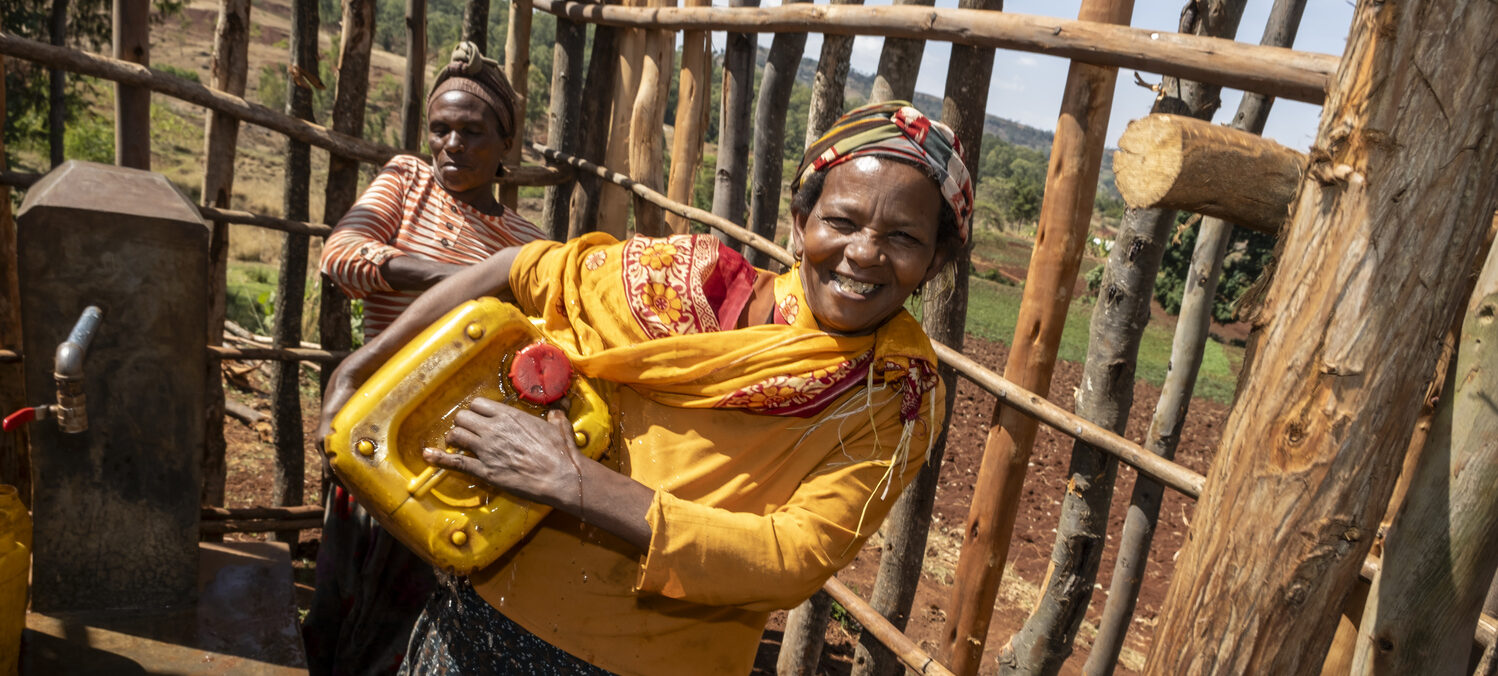
As the water flows from the tap into her jerry can, 47-year-old Beshike Banga is beaming in her bright yellow top. Just minutes ago, the wooden gate to one of the water points in her home village of Desgale, around 400 kilometres south of Addis Ababa, was opened. The residents of the community in the Boreda project area can draw water here twice a day. Beshike and her family of twelve can use it to cook, clean, shower and wash. “Above all, we can drink it without fear,” says Beshike.
That wasn’t always the case. The Meti Koro river used to serve as a water source for the village. Now, in the dry season, it babbles as a rivulet in a basin below the village. The danger posed by the little river cannot be recognised at first glance. But it is abundant, in the form of parasites that make people ill. Beshike also suffered from gastrointestinal complaints on several occasions. Once she had to be treated in hospital and borrow money for the medication. But she was hit the hardest when she swallowed a leech about three years ago.
“It was still very small, so I didn’t see it,” Beshike reports. The parasite got stuck in her throat, latched on and became engorged with blood and grew bigger and bigger. Beshike felt something strange in her throat, and a little later she spat up blood. “I was totally shocked and was afraid I was going to bleed to death,” she recalls. People from the village rushed to her aid.
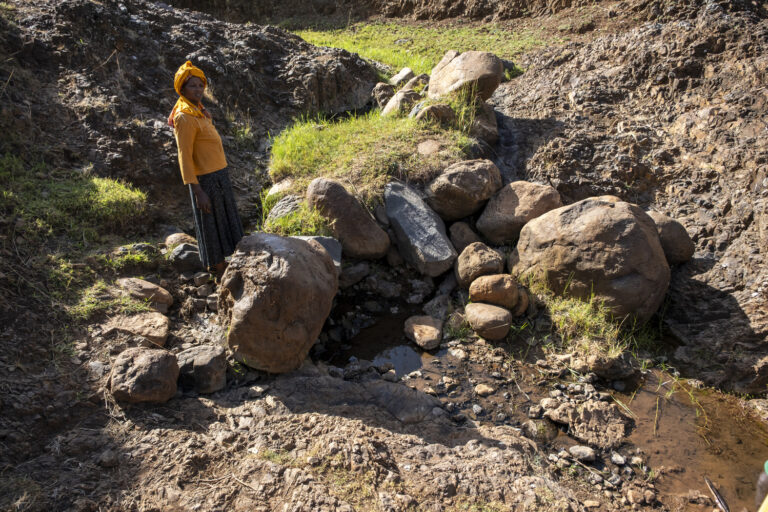
While some people held her mouth open, her neighbour Dera Balcha carefully insert ed a thin thorny branch into her throat. “I skewered the leech with it and pulled it out,” explains the 52-year-old. Others were also affected by the leeches. The villagers therefore began to draw their drinking water from a distant spring built by the government. It took them around three hours just to walk there and back, plus the waiting time on site.
Tesfalidet Gebrekidan, head of the Boreda project area, remembers it well: “When we visited the community for the first time, everyone complained about how difficult it was to get clean water.” In order to improve the situation, Menschen für Menschen built a whole supply system: a natural spring three kilometres away was contained. It feeds two water reservoirs from which the water flows through pipes to the three distribution points in the village. “Everyone in the village pitched in with the construction work,” reports Dera. They hauled stones and cement, dug deep holes and donated wood for the fences.
To enable the villagers to maintain the system themselves, Menschen für Menschen has trained a water committee. In a training course lasting several days, the seven women and men, including Beshike and Dera, were given a small toolbox and learnt how to carry out minor repairs, replace individual parts and clean water tanks and dispensing points. Members of the committee open and close the distribution points, while others collect the small monthly user fee of around 70 cents per household.
Parasites are not just a problem for humans, but for their animals as well. Some, including a pregnant cow from Dera, died as a result. Now the farmer is hoping that they will soon have better health too: drinking troughs for the animals are soon to be installed in Desgale.