
The return of the forest
A home for human and animal
In southern Ethiopia, Menschen für Menschen is launching the largest reforestation project in its history to date. Local indigenous tree species are to be planted on around 10,000 hectares in order to regenerate damaged mountain forests and improve the living conditions of more than 300,000 people.
In harmony with the forest
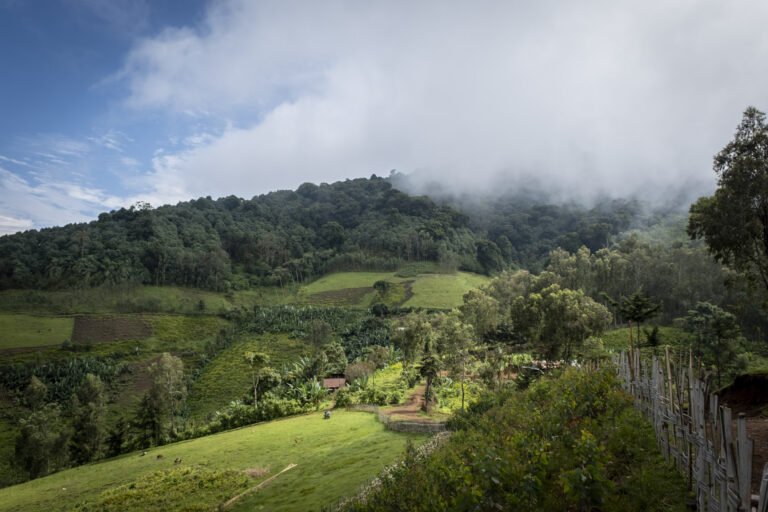
If Emamo Etso wants some peace and quiet, he goes into the woods next to his property. Over several kilometres, stone yew trees, cordia and juniper trees are scattered in the deep green. Often, thick fog hangs between them, providing moisture for trees and mossy forest soil. Frogs, snakes, porcupines, monkeys, hyenas and numerous bird species live in the Sirso – the “cold forest”, as people here in the village of Mayzelo call it.
They have benefited from it for a long time. They hunted wild animals, picked forest berries and hung traditional beehives in the trees. To get the honey, they cut off branches. So did Emamo’s father. Nevertheless, man and nature lived in harmony. Only as the village grew, families grew larger, and people needed more space to live, did this balance falter.
A new large protected area
“We too cut down trees to make our fields bigger,” recalls Emamo. Six years ago, government workers came to the village and declared the Sirso a protected area. “I didn’t want to accept that at first,” he says. He only agreed once the authorities provided him with modern beehives for his property and showed him how to harvest the honey. Today, the farmer takes responsibility himself: he’s a forest guard. If he and other volunteers catch someone illegally felling trees or hunting, they turn them over to the police. Depending on the offence, there are high fines or up to three years in prison.
The Sirso is also very important for Menschen für Menschen. It acts as a reference forest: “In this forest, we see what vegetation there used to be,” explains Misaw Atalay, head of the Gofa project area. This information is needed because the Foundation will implement a major forest and biodiversity conservation project in Gofa and in two neighbouring regions. Almost 10,000 hectares of forest are to be returned – an area of about 14,000 football fields.
In the mountainous area, the problems are similar everywhere: for decades, people have cut down large areas of forest to produce firewood and land for agriculture. Without the tree roots, the steep slopes lost their hold. There were dramatic landslides and crops were destroyed. Reforestation, supported by national and local authorities, therefore has multiple benefits: it stabilises soils and strengthens resilience to climate impacts. It also serves the regeneration of a unique ecosystem – the evergreen Afromontane mountain forest. It is one of the world’s biodiversity hotspots.
“This project, with its claim to combine forest conservation with an improvement in people’s living conditions, is the consistent continuation of our previous work,” says Foundation Board member Sebastian Brandis. “On this scale, it is unprecedented for us so far.” The project is financed by companies or public donors looking for projects for high-quality certified CO2 sinks.
CO2 in the atmosphere can be reduced in two ways: through lower emissions or through new carbon sinks such as forests. Emissions trading brings this into a market-based system. In addition to European emissions trading, which limits CO2 emissions by only issuing a certain amount of emission allowances, there is a voluntary market for projects that are proven to bind CO2 or avoid emissions.
High-integrity CO2 certificates are only awarded for projects whose climate impact is scientifically proven, independently assessed and secured in the long term. Ideally, they will also improve the living conditions of local people. The Menschen für Menschen reforestation project in the Eastern Afromontane hotspot is aligned to this standard; certification is still pending.
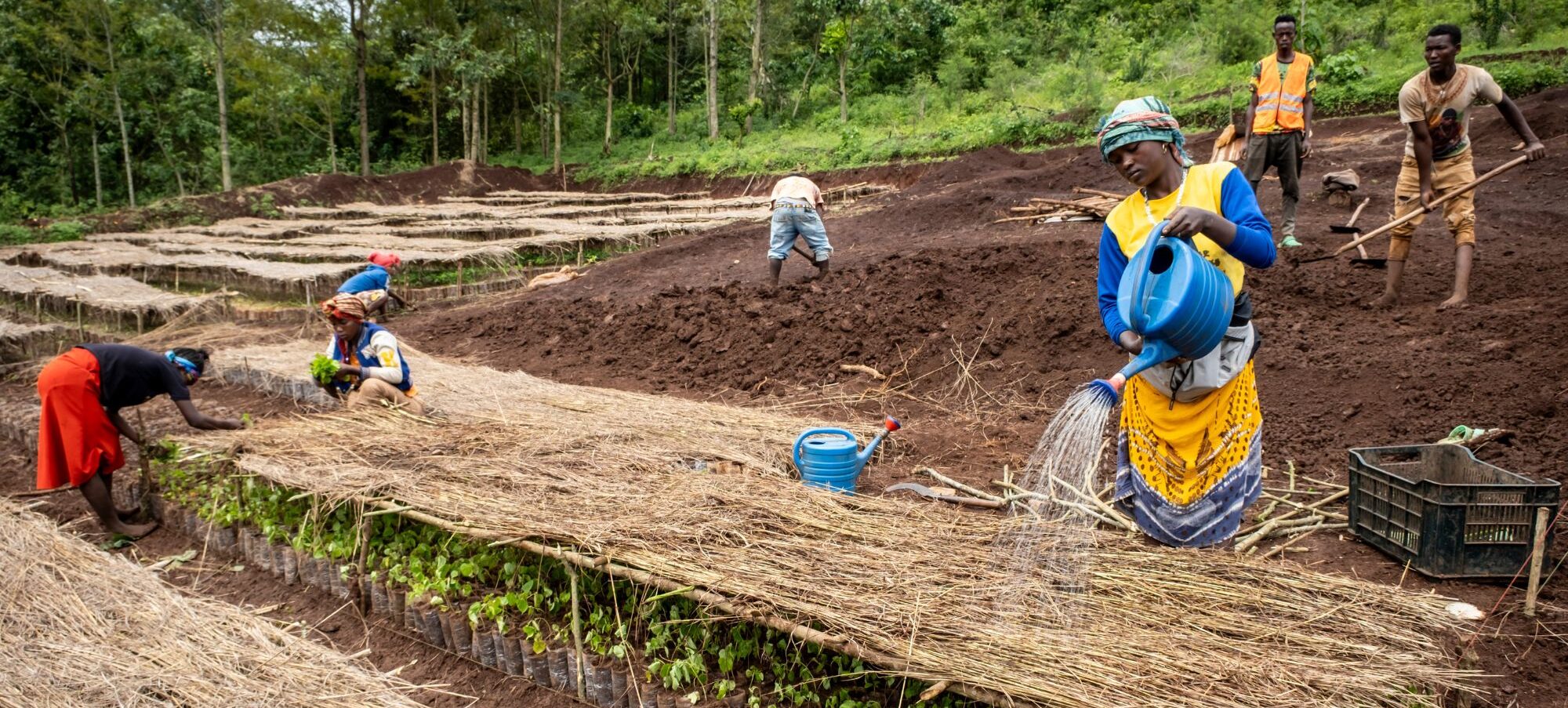
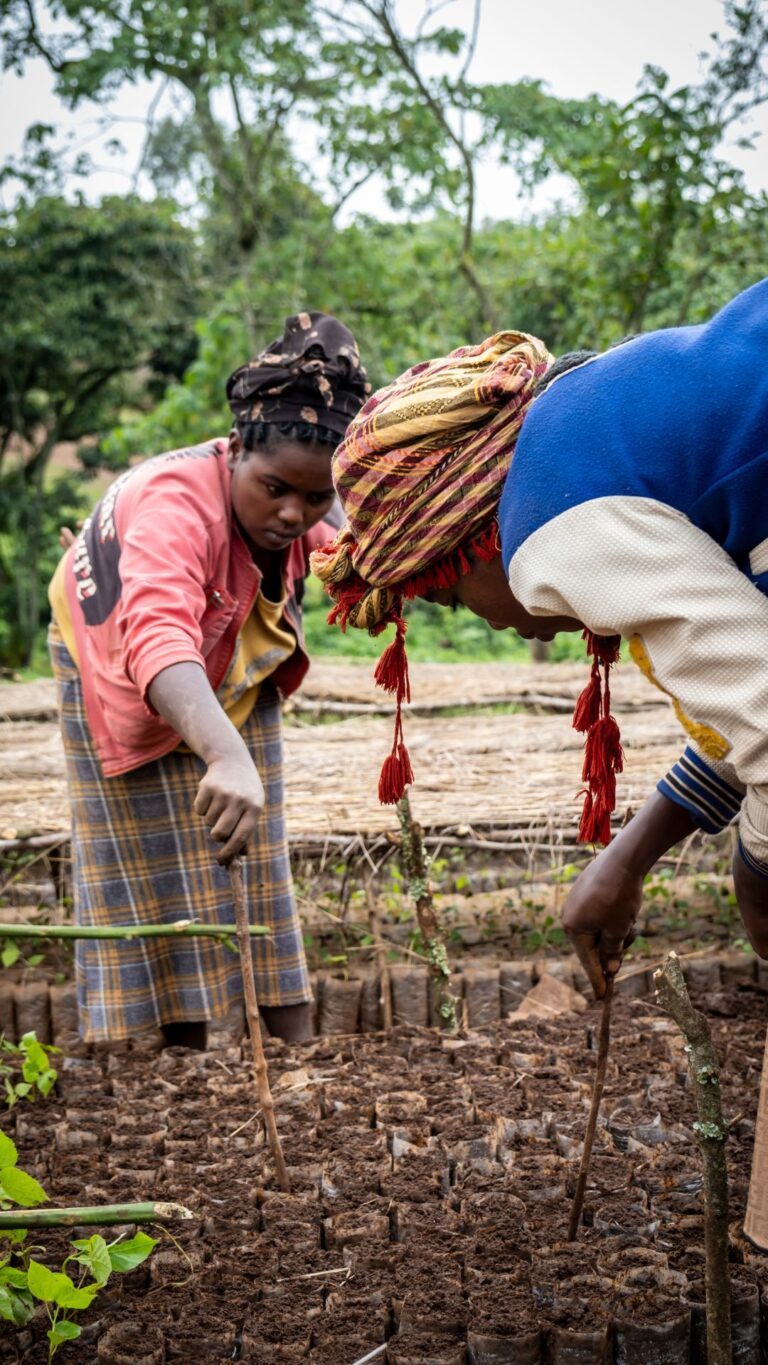
In order to collect data and later document progress, experts from the Foundation, and from the universities in Addis Ababa and Arba Minch, have travelled to the region in recent months. For a baseline study, they talked to farmers, government representatives and women’s groups about the use of forests so far and studied land-use conflicts. Above all, however, they recorded the diversity of flora and fauna. “In order to restore the forest to its original state, we only plant local indigenous tree species,” says Misaw Atalay. “We get the seeds from the Sirso, among other places.” To increase their number, Menschen für Menschen have already opened five nurseries. In 2026 alone, up to one million seedlings are to be grown for the first 1,000 hectares of reforestation.
The nursery in Basketo is bustling. Employees carry baskets of young plants to nursery beds; others pull weeds or water the seedlings. “It’s hard physical work,” says Hayimanot Ayele. Every day, the 20-year-old runs several hours to the nursery and back home. Nevertheless, she is grateful for the job. Very early, at the age of 14, she became pregnant and was unable to move up to the next school year. Hayimanot has been a single parent for some time. Just a year ago, she was hired out as a cook in a restaurant in a larger city. “I hated it there,” she says. She worked there every day until late in the evening, her daughter did not see her for seven months.
Added value also for the communities
Hayimanot now earns almost twice as much in the nursery as she did in the restaurant. “I can also put my daughter to bed every night and spend Sundays with her,” she says. Hayimanot saves part of her income in order to be able to go back to school one day. “Who knows, maybe I will study medicine later. Or agriculture.”
The seedlings are an important part of the reforestation of the mountain forests and are already creating important jobs in the nurseries. “Once the project is certified, 60 percent of the proceeds from every CO₂ certificate sold are to benefit local people – for schools, health centres and roads.” “This is often not sufficiently considered in other projects,” says Sebastian Brandis. Often the focus is solely on the forest or individual animal species. But the people who are supposed to protect the trees need clean water, health care and safe paths. “Only if people’s socio-economic situation improves noticeably as a result of their commitment to nature will there be a strong and lasting motivation to preserve the forest in the long term.”
More than 300,000 people are expected to benefit directly and indirectly from the Foundation’s activities in the early years. However, it will still take a few years before the first CO₂ certificates can be sold. The forest must first grow and build up new biomass. In order to support the communities during this time, Menschen für Menschen founded a non-profit corporation in 2025. The Foundation can use this to attract investors to the reforestation project. “They are new forms of financing,” says Brandis. “But our commitment on the ground remains the same.
Committed forest conservationists
The importance of this can be seen in the village of Saziga. Deep furrows and ditches run through the community. In the rainy season they fill up with water and mud from the surrounding hills. “The paths through the village turn into rivers,” says farmer Nigus Manaye. “We will not be able to leave our properties and will have to pay special attention to children and animals.”
Nigus Manaye owns around two hectares of land in Saziga. As with many of his neighbours, his fields are scattered throughout the community. One of them is located high up on the slope. Corn is growing there. When it’s almost ripe, Nigus won’t lose sight of it. At that time, he spends the days and often the nights in a crooked wooden hut on the edge of the field. When he hears a rustle, he runs out and screams.
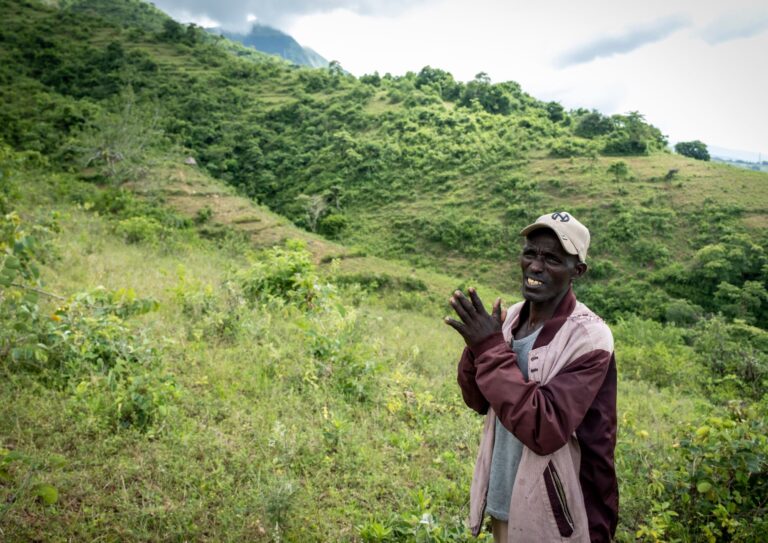
He tries to drive away monkeys that rip the corn cobs from the plants. “That’s the only thing that helps,” says the 45-year-old. Erosion and hungry monkeys – these problems did not exist back when there was still dense forest around Saziga. The trees held back the rainwater and provided the animals with sufficient food, so that they mostly stayed away from the settlements. Today, only small, scattered forest islands remain. “We want to reconnect them into a cohesive ecosystem,” explains Misaw Atalay. In total, the protected area is to cover 129 hectares, including Nigus’ uppermost field.
He doesn’t mind that he won’t be able to grow anything there soon. On the contrary, he can’t wait for the first young trees to be planted. Menschen für Menschen also supports families with coffee and fruit tree seedlings and shows them how they can achieve higher yields in their remaining fields, for example with the help of agroforestry or worm compost. “We are already making sure that no more forest disappears,” says Nigus. “We have to protect it.”
Just like forest guard Emamo protects his Sirso. “The trees are like my children. I have to look after them.” Perhaps one day many other people in the region will be able to talk about the new forests in this way.